A real change in the business by month twelve
Not a better month. A business that looks different from the one you brought to the first session, in figures you already keep score in. You decide at joining what the year has to be worth to you, and in month seven and month thirteen we hold it up against what actually happened.
More profit, and more of it to you
Busy all year and the profit is not there, prices you know are too low, and you paying yourself last. Pricing and margin go on the board until the numbers move.
Turnover past where you have stalled
The same size for three years, one client who is a third of the business, more work out there than you have people for. What the next size is and the decision that gets you there.
Sales that do not all run through you
If you are not out selling, nobody is, and one bad month of yours is a bad quarter for the firm. Who else can win work, and how.
A business that needs you less
Everything still comes back to you and it is all in your head. Either you step out of the day to day, or you step up into the work only you can do, and the business keeps running either way.
A business worth more, whether or not you sell
You find out how the year went when the accountant tells you, months late, and you are not sure anyone would buy it. What drives the value, and what moves it.
Each of these is a thing you can measure in your own accounts. None of them is a feeling.
Four men as serious about their business as you are about yours
Five men who own and run businesses, meeting twice a month with a whiteboard and me, to work out what is next for each of them and for the business, and then to do it.
You have been moderating yourself in every room you are in, for years, and you probably stopped noticing. Ambition in front of your team sounds like pressure and they start worrying about workload. Full intensity at home reads as not being present. So you turn it down, everywhere, all week.
Nobody here needs protecting from your ambition
None of them works for you, buys from you or lives with you. So you can say the whole thing at full size, and watch what four men do with it.
You stop being the most driven man in the room
Probably for the first time in years. It is quietly humbling and it makes you faster.
Nothing leaves the room
That is not there to make it comfortable. It is what makes the rest possible, because you cannot go flat out somewhere you have to be careful.
Ask anyone who has done a HYROX why they went quicker on the day than they ever did in training. It was not the programming. It was the man beside them.
Five in the circle, not thirty. Your challenge goes on the whiteboard every month, everyone knows what you are carrying, and somebody asks you next month what happened. Nobody trains properly for a race they have not entered. That is what the twelve months is.
What you turn up to
You set the targets. Four men doing the same make sure you hit them.
Every fortnight, you tell the circle where you have got to with what you set out to do. Every month, you put whatever is pressing on the whiteboard, the five of us work it through, and you leave with the first step written in your own hand. Every few months, the full hour is yours, on the biggest thing you are taking on.
We walk, whatever the weather
All five of you and me, outdoors. You change who you walk beside so you speak to everyone. Saying the hard thing is easier when nobody is looking at your face.
Coffee is waiting
It is ordered ahead and delivered to the room, so nobody loses twenty minutes to a queue. The walk loosens the thinking, the room finishes it.
One man, the full hour
The biggest thing he is taking on goes up and stays there until it has a shape and a first step he can take on Monday. He writes that step on the whiteboard himself before he sits down. The full hour comes round to each man roughly every five months.
Then two men, half an hour each
Whatever is pressing. Half an hour gets somewhere when four men already know your business, and it ends the same way, with a line in your handwriting and a date against it.
A fortnight later, online
The first half hour is all five of you saying where you have got to with what you wrote on the board last time. Four times a year this half hour becomes the numbers round. Then two men take half an hour each on the board.
Just you and me
Ninety minutes with the whiteboard, for whatever you are not ready to say in front of the other four yet, and for the pattern I have seen in your decisions since we last sat down.
Every man is on the board every month. The full hour is yours roughly every five months.
In person at the Shire Retreat, Milton Keynes. Online between sessions. Members come from across Milton Keynes and the surrounding area.

Everything you commit to goes on the board
Every time you are on the board, full hour or half hour, you finish by writing one commitment in your own handwriting, with your initials and a date next to it, in front of four other men. Next session it gets checked. Not by me, by them.
“Not yet, and here is why” counts. Saying why is the rep.
We photograph and film the walk and the room from time to time. Faces are in it by choice, and nothing on the whiteboard is ever readable. Members use the pictures in their own content if they want to, because being in a circle is something to show.
A business does not stop for a bad quarter
Your company goes through seasons. Good months, thin months, the quarter where three things go wrong at once. You do not get to sit those out, and neither does this.
So we walk in the rain. We walk in January. If it is coming down hard we take the shorter loop and get wetter, and the session happens exactly as it would have done.
You do not miss a meeting. That is not strictness for its own sake. It is the only way four other men can rely on you being there.
Twelve months is a long effort, so it runs as four
Three months at a time, with the numbers round at the turn of each quarter and a day to recharge before the next one starts. Month thirteen does the same job for the fourth.
The numbers round
Four times a year, the opening half hour online becomes the numbers round. Each man says three figures out loud: turnover for the quarter, profit for the quarter, and one figure of his own choosing. You set each one against yourself, where you were, where you could have been and where you want to be, and the other four ask one question each about what the numbers are telling you. Nothing is written down and nobody is ranked. Five businesses differ in too many ways for a league table to mean anything. What you get is a benchmark against the only business that matters, which is yours, and most owners have not had one since the day they started.
The Reset
At the end of each of the first three quarters there is an optional day, lightly guided, to put down what you have been carrying and keep your momentum into the next three months. Movement first, phones off, then lunch together. Forty-five minutes to get everything you are holding onto paper, sorted into keep, hand over or drop. The afternoon is yours. Then half an hour with me to settle the one thing you carry into the next quarter. It sits on top of that month’s sessions, never in place of one, and you pay for it separately. Think of it the way an athlete treats a recovery week: part of the training, not a break from it.

Small enough that you cannot hide in the middle
Nine things you do not have today
An honest read on how you are doing
No appraisal since the day you started, and the accounts lag a year. Four times a year you say your numbers out loud and set them against where you were and where you want to be. Most owners have never done that in front of anyone.
Four more businesses to learn from
You have run one company, through one downturn, from one seat. Everything you believe about pricing and hiring comes from a sample of one.
Somebody going at it as hard as you
Staff want security, customers want service, your family wants you off the phone. Name one man you spoke to this week who wanted nothing from you.
Men who will tell you when you are wrong
Being the most capable person in your own building is comfortable and it has made you slower. Nobody has properly disagreed with you in years.
Somewhere the bigger plan is taken seriously
You had one and stopped saying it out loud, because saying it invites the question of why it has not happened. Here it gets said, then tested against what it would take.
Men who understand what it took
Best month in the firm’s history and nobody to tell. Not the staff, who would ask about pay. Not at home. Four men know exactly what that month cost you.
An explanation of your own instincts
Every member does CliftonStrengths on joining. Why you keep hiring the same man, and why some decisions stall for months.
A year of watching men unlike you
Four owners built completely differently. That does more for handling the difficult person on your team than any course.
And one built exactly like you
You hear your own reasoning come out of another man’s mouth, and see what it is doing to his business, with none of your defensiveness in the way.
Every slot starts with the same question. What’s next?
For you, and for the business. Your challenge goes up on the whiteboard however it comes out, and where you are starting from decides how the hour runs.
You do not know what’s next
We work out exactly where you are trying to get to, then lay out the options for the next step, so you are choosing between real moves rather than staring at a blank.
You know the next step, but not how to take it
We open it up and put more ways of doing it on the board than you would have found alone. Four other owners have usually taken a version of that step already.
You want to move, but you are buried in the detail
We step back, connect what is in front of you to the bigger picture, and then you decide. The detail is still there when you get back to it.
The other four look in from outside, and that matters more than it sounds. An owner goes nose blind to his own business. You are so close to the detail that you stop seeing what is obvious to anyone walking in the door for the first time. Four men walking in the door is the point.
As it goes up on the board
Find the connections
Most of what looks like six separate challenges turns out to be two.
Find what is missing
The information or the numbers you have been deciding without.
Find your blind spots
Where your own way of leading is sitting inside the challenge, causing part of it.
Get to the real cause
Not the version at the top, which is usually a symptom.
Work out what will hold
Which solutions survive all of the above, and which quietly will not.
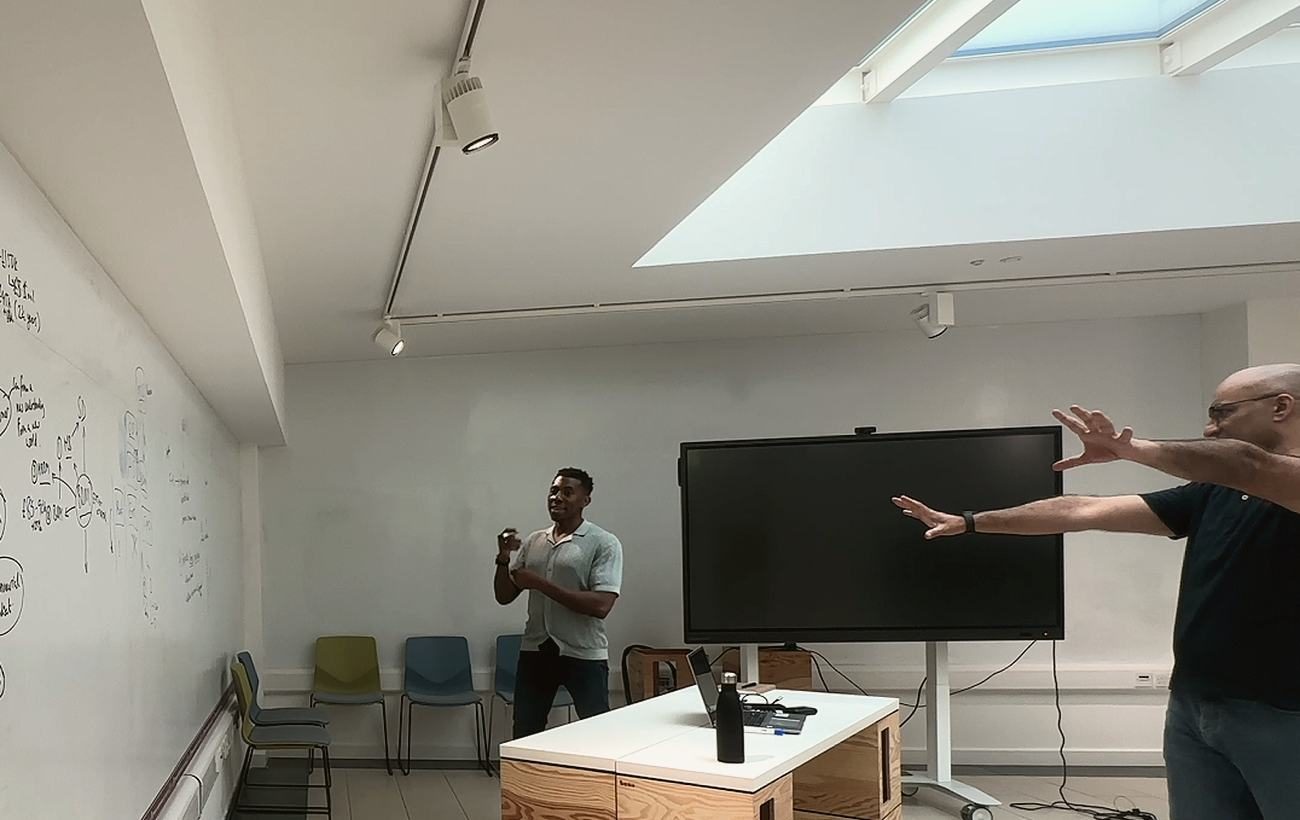
Every slot is working towards one moment. The point where the approach becomes clear, the strategy with it, and so do the next steps. You know when it has happened. You leave with the first of those steps written on the board in your own hand, and that is what the other four ask you about next time.
When the bigger plan needs money, people or kit you do not have yet, that goes on the board too: where it could come from, and what it would cost you.
By then I know how you are wired, so my questions are aimed at the way you think. The first part of every slot is yours and mine: I ask, you answer, nobody else speaks. Longer in the full hour, shorter in the half hours. Then the floor opens and the other four come in with their questions and their views. That is how the room runs, and I hold it to it.
Near each other, on purpose
Meeting twice a month for a year is long enough that these stop being four men you meet and start being four men you know. Which is when the useful part starts.
One of them rings you on a Tuesday because he has just been offered something and wants a view before the end of the day. One passes you a name worth having, a bookkeeper who is actually any good or a solicitor who answers the phone. None of that happens if the five of you are scattered across the country and the only contact is a booked session.

What the room asks of you
Six rules, and they are the reason it works. Every man signs up to the same ones before his first session.
You turn up
Twice a month, for twelve months. Not when it suits, and not only when the weather is good.
You bring something real
Not the summary. The thing you have been going round in the car.
You do what you said, or say why not
The first half hour of every online session is exactly this. “Not yet, and here is why” counts.
You wait your turn at the board
The first part of every slot is the man on the board and me, questions only. Then the floor opens and you come in. Nobody jumps in early, and I hold the line on it.
You keep it in the room
All of it. That is what makes the rest possible.
If a man is coasting, the other four say so
Out loud, in the room, before I have to.
Four men who will hold you to what you said, and never repeat a word of it outside the room.
If you drift
The rules are what make the circle something you can fail at, which is why it is worth being in. So there is a line, and here is where it is.
Miss two commitments in a row without saying why, and you and I have a conversation before the next session, to find out what has changed. A third, or a pattern across a quarter, and we talk about whether the circle is still right for you this year. If the drifting carries on, you step out. You stop paying, you go back on the waiting list to join a later circle when the time is right, and your seat goes to the next man waiting, so the other four keep a circle of five.
A missed commitment with an honest reason does not count. Nor does a planned break. Saying why is the rep.
“Will I be the one who is behind?”
Almost everybody wonders it. Almost nobody says it.
Circles are not built by size of business. They are built by whether five men are stuck on challenges they can usefully think about together. Nine staff and a partnership falling apart is more use to twenty-four staff and no successor than any matching turnover would be.
You are not measured against the other four. You are measured against where your own business was a year ago, and that is the only comparison that tells you anything.


John Obidipe
John Obidipe runs at.theboard. He has spent more than fifteen years in organisational consulting and executive coaching, is Gallup-certified in CliftonStrengths, and has coached leaders inside Toyota, Convatec and the University of Oxford as well as owners running firms of £500k to £5m. Every member takes CliftonStrengths when he joins.
I will not tell you how to run your business. What I will do is bring what I have seen work and fail in other companies, large and small, and then find the answer with you rather than hand you one.
There is no good reason to solve something with one mind when you can put six on it.
Men who own and run the business
- You own it and run it day to day
- Turnover £500,000 to £5 million
- Five to twenty-five staff
- Still doing the work yourself
- Going at it, not coasting
- Looking for men to sell to
- Looking for a speaker or a conference
- Want somebody to tell you what to do
- Would not say the real thing in front of four others
- Would coast for a month and let the others carry it
The hour is free and open to anybody. A place in a circle is not. I build these rather than fill them, because in a circle of five, one man coasting costs the other four their year.
If your business is smaller than this and you are going at it, book the hour anyway. The range is a guide to who sits well together, not a door.
Every man comes in through the whiteboard, and nobody joins without being placed
Five steps, in this order. None of them is a sales process. They exist so that the four men you sit with are the right four.
A free hour at the whiteboard.
Open to anyone. Whatever is live in your business goes on the board, and we work it until it has a shape. No pitch at the end. It is how I find out who you are, what your business is and what you are going at.
The waiting list, and your place.
If a circle is right for you, you go on the waiting list until I can place you in the right one. Every circle is built for variety. No member does what another member does, so you are never sitting across from a competitor, and you spend the year looking at four businesses nothing like yours.
The rules, agreed in writing.
The six rules above, and the drift rule. Everyone signs the same ones.
CliftonStrengths 34.
Done before your first session and talked through in your first one-to-one. It is how I know how you are wired before you are on the board.
What the year has to be worth.
In that first one-to-one you write down, in your own terms, what would make the twelve months worth the money and the hours. It sits at the top of your record. We hold it up again in month seven, and in month thirteen you say whether the year delivered it.

Three sessions, then you decide.
Membership runs for twelve months, because a circle men drift in and out of stops being a circle.
But you cannot tell from one hour whether these four are the right four. So your first three sessions, roughly six weeks, are yours to walk away from. Say so and we stop, with nothing to pay for the rest and no conversation about why.
Month thirteen, together
Twelve months of this should not simply stop. The first week after the year is done, the five of you go away together.
Your twelve boards, on the wall
Every commitment you made and every tick, printed and up in the room. It is the only record of the year that exists.
Each man’s year, out loud
What he said in session one and what actually happened. Twenty minutes each, and the only time the circle looks backwards.
Another twelve months, or not
Decided in the room, face to face, rather than by email in month eleven.
What you wrote at joining
What you said the year had to be worth, read back in the room, and whether it did. Then each man says what he is going towards next.
Priced separately and at cost, because I make nothing on it. Named at joining so it is part of the shape of the year rather than something sprung on you in month eleven.
Three ways to go further than the circle
The circle is the spine of it. These are open to members only, and none of them is pushed at you.
One to one with me, fortnightly
Instead of the ninety minutes every two months. For a year where a great deal is happening at once.
Coaching your second in command
Six sessions over three months with the person who could run things when you are not there. The same work I do with owners through BuildStrong, open to members at the member rate.
A day with your whole team
All of them in a room with the whiteboard, working the decisions that currently reach your desk by default.
What membership includes
£550 a month is the price for the first circle only. Later circles pay more, and a man who joins the first one keeps his rate for as long as he stays. For six hours a month with four other owners and me, one avoided mistake at your size pays for the year.
What owners ask before they join
Is there a men’s business group in Milton Keynes?
Yes. at.theboard is a circle of five male owner-managers in Milton Keynes who meet in person every month at the Shire Retreat and online a fortnight later, for twelve months. It is a business peer group for owners who want to be pushed on their numbers and their decisions, rather than a social or wellbeing group.
Who is it for?
Men who own and run a business in or near Milton Keynes, usually with £500k to £5m turnover and five to twenty-five staff, who are still doing a lot of the work themselves and want four other owners holding them to what they say they will do. Smaller businesses are welcome to book the free hour and talk.
How often does the circle meet?
Twice a month. One in-person half day at the Shire Retreat: a sixty-minute walk, coffee, then the whiteboard, where one man takes a full hour and two men take half an hour each. A fortnight later, ninety minutes online. Each member also has ninety minutes one to one with John every two months. That comes to about six hours a month.
What does a year in the circle change?
The business, in figures you already track: profit and what you take home, turnover past the point where you have stalled, sales that no longer all run through you, a business that can run without you for a fortnight, and what it would be worth to a buyer. Each man writes down at joining what the year has to be worth to him, and the circle holds him to it in month seven and month thirteen.
How long do I commit for?
Twelve months. The circle stays the same five men for the year, because the value comes from people who know your business well enough to notice when you are coasting.
How much does it cost?
£550 a month for members of the first circle, held at that rate for as long as they stay. Later circles pay more. Month thirteen and the quarterly Reset day are priced separately at cost.
How is this different from a networking group?
Networking groups in Milton Keynes meet weekly or fortnightly to pass referrals. at.theboard has no referral target and no selling in the room. Five owners work on each other’s real decisions, and every commitment is written on the whiteboard with a name and a date.
How does it compare with Vistage or The Alternative Board?
Both are established peer advisory options. Vistage groups usually have twelve to sixteen members meeting for a day each month, and The Alternative Board runs monthly advisory boards in Milton Keynes. at.theboard is smaller, five men, with every member on the whiteboard every month, a walk built into each session, and a fixed twelve-month circle.
How do I join?
Start with a free hour at the whiteboard with John on whatever is live in your business. The free hour is open to anyone. A place in a circle is not. If a circle is right for you, you go on a waiting list until John can place you in one where nobody does what you do. The first circle is being selected now.
How at.theboard compares with the other options in Milton Keynes
An hour at the whiteboard. Free.
It goes on the whiteboard
Whatever is live this week, in your words, not the tidy version.
You leave with something to do
We stay with it until it has a shape and something you can act on Monday.
No pitch afterwards
Free whether you join or not. No follow-up sequence.
I say what I think as we go rather than saving it up for the end. That includes telling you if what you have is a process problem rather than a judgement one, in which case I will say so and send you off to fix the process. That happens, and it costs me the work, which is fine.