Executive coach. Strategy and change consultant.
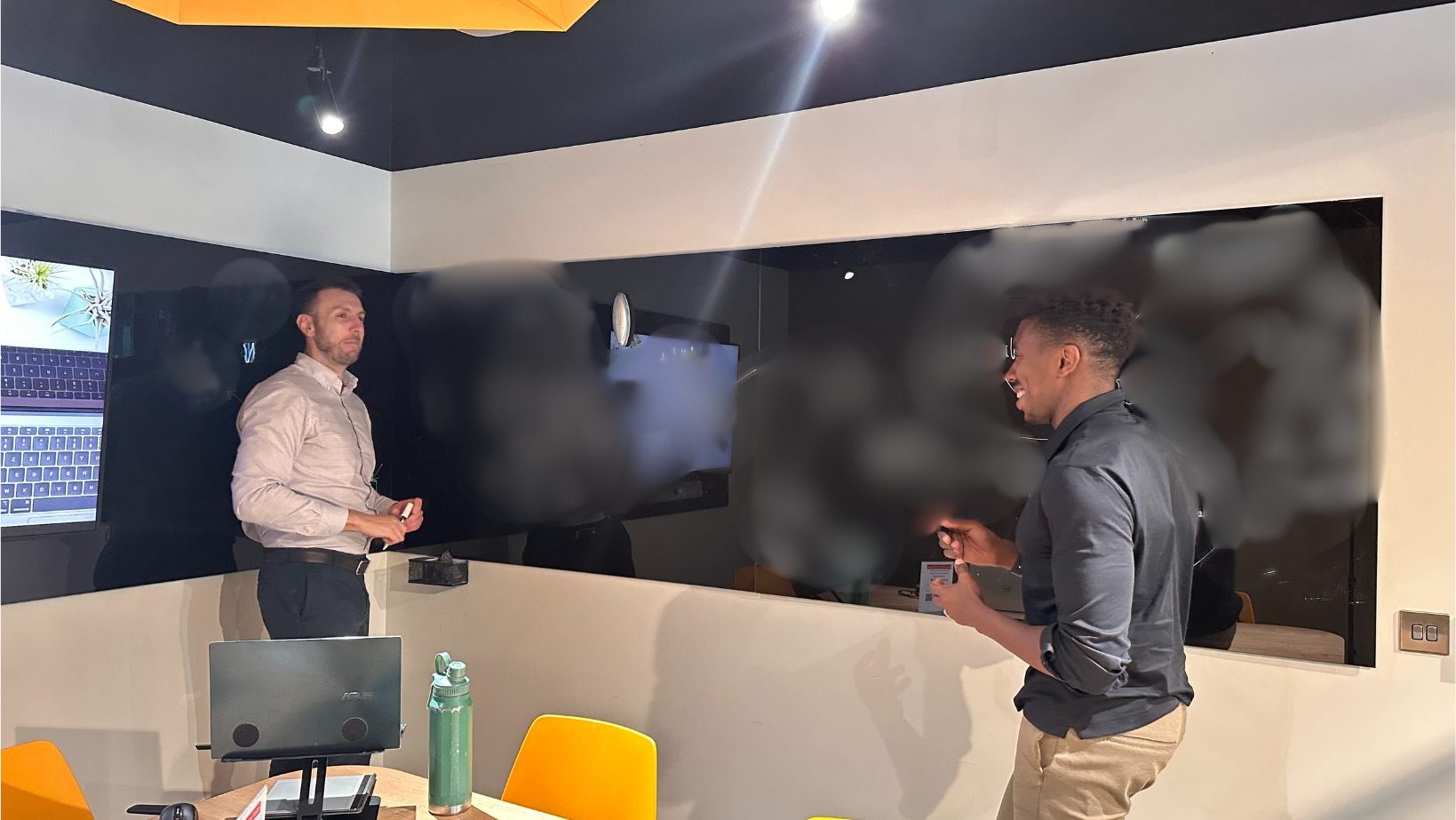
Sits at the other end of the whiteboard.
For over a decade I consulted to organisations on change, business architecture, and strategy. That's where the organisational instinct comes from.
Alongside and after that, I trained as an executive coach and built a practice with senior leaders, directors, VPs, and founders. That's where the people-side instinct comes from: how high-performing leaders behave under pressure, where their patterns trip them up, what changes when the right question gets asked at the right moment.
The Whiteboard Sessions are what happens when those two careers sit at the same board.
The board makes the thinking visible. It externalises what would otherwise stay in your head. You can see the connections, the gaps, the place the argument breaks. You can move the pieces around and watch what changes.
Most weeks, the leaders I work with don't get an hour to think this way. The session is where they do.
The most-used talent assessment in the world, used by 90%+ of the Fortune 500.
Uses the 16-archetype model derived from CliftonStrengths in coaching engagements.
Organisational consulting and executive coaching across plc, private and entrepreneurial contexts.
Clients across industries and countries. See selected clients below.


Alongside the organisations above, individual leaders coached from AWS, Volkswagen Financial Services, Nexans and Bassett Mechanical, among others, across industries and countries.
i. Mixed questions, asked directly.
Reflective when the moment calls for it. Practical when there's a real problem to solve. Obvious when no one else is willing to ask. The work is done in the room, through to a solution. Not in questions you take away.
ii. I'll tell you when I think you're the problem.
Not bluntly. Not unkindly. But I won't pretend not to see it, because that's the most expensive thing a coach can do.
iii. Long-term by default.
The clients who get the most from this work tend to stay for years. Not because they're stuck. Because the thinking partnership compounds.
I wasn't the academic child. Nigerian parents who wanted a doctor, a lawyer, an engineer or an accountant, and a route through private school and boarding school designed to produce one. They're sweet people and they wanted the best for me. But each time I did something well, it still landed as a disappointment. I can still picture the headteacher's office and his face at two A's, five B's and a C.
When the university applications came round I declined all the advice and read menswear fashion design instead. It was the first decision that was properly mine. It also taught me the thing I've used in every role since: how to turn creativity into something that answers a brief.
Then a decade of consulting. Transformation projects, target operating models and multi-million-pound procurements, for the University of Oxford, the Open University, University of the Arts London, the University of Portsmouth, the University of London, Cambridge University Press, Autoglass, Scania, Sainsbury's, Morrisons and Asda, among others. Business analyst, project manager, product owner — different hats, one thread. Helping organisations understand themselves, untangle complexity and move forward with clarity. The principles turn out to work on the leaders inside them too.
Then a book, StrengthsFinder 2.0, which gave me language for something I'd been doing without noticing. I can see what's great about a person, usually before they can. That's the ability the whole practice sits on.
The best leaders are whole people. Not performers. People who know what matters to them and build everything from there.
The rest of the story — family, faith, what rest is for — sits on johnob1.co.uk, John's own site. It opens in a new tab.
Ready to be at the board?
Book a Whiteboard SessionOne hour. No charge, nothing to prepare.